$518B Surplus: Exports Boost Economy
In the past two years, among the three engines of export, consumption and investment have both entered a period of decline along with the downturn in the real estate market. The reason why China can still maintain an economic growth rate of around 5% is largely due to the contribution of exports!
1. Exports: The Ballast Stone of the Economy
In July, exports once again showed a growth trend.
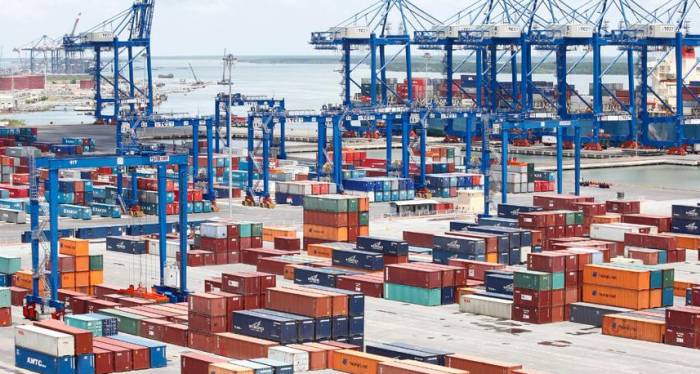
According to the General Administration of Customs, in the first seven months of this year, the total value of China's goods trade imports and exports was 24.83 trillion yuan, a year-on-year increase of 6.2%; exports were 14.26 trillion yuan, an increase of 6.7%; imports were 10.57 trillion yuan, an increase of 5.4%.
In July alone, imports and exports were 3.68 trillion yuan, a year-on-year increase of 6.5%; exports were 2.14 trillion yuan, an increase of 6.5%; imports were 1.54 trillion yuan, an increase of 6.6%. In July, both year-on-year and month-on-month growth were achieved, with the year-on-year growth rate remaining above 5% for four consecutive months.
Exports have earned us a lot of money, so against the dual background of economic downturn and a strong US dollar, the renminbi exchange rate can still remain stable.
If calculated in renminbi, the trade surplus is 3.69 trillion yuan, an expansion of 10.6% (an expansion of 12% from January to June). If calculated in US dollars, the trade surplus is 518 billion US dollars, an expansion of 7.9% (an expansion of 8.6% from January to June).
2. Export Structure: Significant Upgrade
In China's exports, it is evident that the industrial structure is continuously upgrading.
For example, from January to July, the export of processing trade decreased by 0.2%, while imports increased by 9.7%, indicating that less was sold and more was purchased.What is processing trade? It involves importing parts, assembling them, and then exporting the finished products, which is the least profitable model. It's similar to Foxconn's assembly plants; although the revenue looks substantial, the profits are mostly made by others.
The reduction in such processing trade indicates that China is decreasing its low-end industries or transferring them overseas, such as to Africa.
Let's take a look at the changes in new industries.
In the first seven months, China exported mechanical and electrical products worth 8.41 trillion yuan, an increase of 8.3%, accounting for 59% of the total export value. Among them, automatic data processing equipment and its components were 815.88 billion yuan, an increase of 11.6%; integrated circuits were 640.91 billion yuan, an increase of 25.8%; automobiles were 462.86 billion yuan, an increase of 20.7%; mobile phones were 454.74 billion yuan, a decrease of 1.3%.
Among these, automobiles and semiconductors are particularly significant highlights. Automobiles not only saw an export increase of 20.7%, but imports also decreased by 7.4%. The combined effect is equivalent to a 28% increase, which is the most powerful area of the Chinese economy at present.
The export of integrated circuits directly increased by 25.8%, and although imports also increased by 14.4%, the net export still maintained a relatively high growth rate.
See, even though China's economy is currently in a downturn, its industrial upgrading is progressing smoothly, with no insurmountable obstacles.
In this process, it is evident that private enterprises have become the main force, playing a huge role. Not only do they account for 55% of trade, but they also grew by 10.9%. In contrast, the growth of foreign investment and state-owned enterprises in imports and exports is very weak, almost non-existent.
3. The Great Era of Going Global
Regarding trade, many people worry that future trade sanctions will continue. However, looking at the structure of trade partners, the risk resistance of China's exports has been greatly enhanced.ASEAN is our largest trading partner, accounting for 15.8% of our trade, and it has maintained a growth rate of 10.5%.
The European Union is the second-largest trading partner, representing 13% of our trade, with a growth rate of only 0.4%, and the trade surplus has expanded by 5.1%. The United States is third, with an 11% share, and it is still growing positively by 4.1%, with the trade surplus expanding by 7.2%.
Clearly, China's current trade structure exhibits a characteristic of diversification, with a reduced dependence on any single market and an enhanced control in the global arena. Even if the United States increases its efforts again, it would be futile.
A few days ago, I saw a news report. The renowned investment bank Barclays released a report stating that the widespread adoption of cost-effective lithium iron phosphate (LFP) batteries, mature domestic supply chains, economies of scale, and vertical integration in production in Chinese electric vehicles have collectively provided Chinese automakers like BYD with a cost advantage of up to 40% over foreign automakers.
What is there to fear? Therefore, imposing tariffs is useless; such high profits are enough to penetrate any market barriers. Moreover, China's automotive industry does not have a market presence in Europe and America; even if it is restricted, the worst-case scenario is no growth, and other markets are already performing well.
Furthermore, we must recognize that the automotive industry is just a microcosm of the many industries in China that are upgrading.
On the surface, you see the complete vehicles, but behind the scenes, there are tires, radars, cameras, batteries, electric controls, and electric motors. You might think that's it, but then there are excavators, bulldozers, refrigerators, color TVs, and large sofas, among other industries, all of which are going global on a large scale.
So, there is no need to be overly pessimistic about China's future; it is merely the pangs of the transition period from the old (real estate) to the new (technology) economic drivers. Just get through it, and things will be fine.
4. Beware of the conspiracy of the yuan appreciating too quickly.
A former vice president of Xiaomi said, "I made 200 million for Xiaomi, but I was scolded because Lei Jun said, 'I don't want profit, I want market share!' Competition among enterprises is like this, and so is competition among nations! Therefore, we must be vigilant against the yuan appreciating too quickly.Next door, Japan has already learned its lesson, with its economic development grinding to a halt for 30 years (for many reasons, one of which was the rapid appreciation of the yen).
In the 1980s, much like present-day China, Japanese products swept across the globe, leaving American products in disarray. In 1984 alone, the United States' trade deficit reached a staggering $160 billion, accounting for 3.6% of that year's GDP.
The Americans saw this as intolerable and feared that their industry would collapse if this continued. They directly imposed tariffs on Japanese products, but to no avail. Later, the United States devised a plan, joining forces with Japan, France, Germany, and the United Kingdom to sign the Plaza Accord in 1985. The agreement's content was to collectively sell dollars on the international market to devalue the currency!
As a result, the dollar plummeted in value while the yen skyrocketed. In September 1985, the yen's exchange rate was still fluctuating around 250 yen per U.S. dollar. Within less than three months after the "Plaza Accord" took effect, it rapidly appreciated to around 200 yen per U.S. dollar, a 20% increase. In less than three years, the dollar depreciated by 50% against the yen, which means the yen appreciated by a factor of two against the dollar.
In fact, during the initial years, the Japanese were so engrossed in the fleeting prosperity brought by the yen's appreciation that they couldn't extricate themselves. Japanese people in the 1980s were treated as VIPs wherever they went because they were incredibly wealthy. With so much money they didn't know what to do with it, they went on a buying spree, even boasting about buying up the entire United States. The stock market and real estate market also experienced a super bull market.
The Nikkei index rose from around 13,000 points in January 1986 to about 39,000 points by the end of 1989, nearly tripling in value. The real estate market was even more aggressive; the total land value in Tokyo at the time was enough to buy all the land in the United States!
By the 1990s, the Japanese suddenly realized something was amiss. The yen's appreciation was too drastic, significantly reducing the competitiveness of Japanese products, making them hard to sell.
On the other hand, regarding the semiconductor industry that Japan wanted to upgrade, the Americans employed high-pressure tactics, directly suppressing Toshiba, much like their current treatment of Huawei.
However, Toshiba didn't manage to hold out like Huawei and eventually backed down. As a result, Japan, without new industries, could no longer support the bubble, and soon the real estate and stock markets plummeted, leading to a near 30-year economic slump!
In fact, the tactic used by the Americans has been employed by the Chinese before.During the Spring and Autumn period, the Prime Minister of the State of Qi, Guan Zhong, wanted to undermine the neighboring State of Chu. He sent people to buy deer at high prices everywhere. The common people, seeing the profit, stopped farming and rushed to catch deer, leaving their land abandoned. When Guan Zhong saw the right moment, he immediately blocked grain exports, and the State of Chu surrendered without a fight.
Nowadays, the United States also wants the renminbi to appreciate, and then buy a lot of goods. Except for high-tech products that are not sold, the rest can be sold to us. When we develop the habit of buying instead of making, and destroy our core industries, then the United States' big sickle will really come! A product that costs 1 yuan can be sold for 100 yuan, and we have to buy it because we don't have it ourselves!


